31 May 2007

A bubble burst!

The past few days have been rather amazing. If you’re not a ‘geek’, then you probably won’t know of all the things happening, but if you are, then I hope you share the same excitement as me! After a rather considerable lean stint in the blogosphere, the general development sphere, things are back to kicking into top gear. I’ll just list out a couple of things that have got me excited and busy the past few days:

Facebook Platform

The biggest and the best announcement :D They opened up their API completely (it existed, but not with so much power) to developers to sit and make applications that interact with Facebook directly, and it’s different components (alerts, groups, etc.). The great thing is that, as a developer, you get to tap into the the best resource which you might need. People!

Facebook’s insanely large user–base opens up to every developer, and all his applications that moment they hit the Application DirectoryI'm glad they screen the applications that are added to this directory, and are avoiding another Firefox extension–type fiasco!.

This afternoon I finished developing my first application for it. It was meant as more of a test than a full fledged commando application like ‘iLike’ or ‘Photos’. You can check it out here, and if you’re on Facebook (why haven’t you added me yet?), add the application and take it on a quick beta spin :) I want to understand the API and all it’s crannies properly before I actually get down to serious app–ing!

Google Gears!

This happened just today, but I think it’s a very good step. From my end, it seems more like a reflex action to all the hype towards making applications for the desktops and frameworks being released to help developers do so. Whatever it is, it is good! The ability for Google services to go offline with you, and then re–sync when you come back online is something that people will appreciate the more that they use, and realise how much they needed this only once they get used to it. Ofcourse, they have a long way to go with this.

What I am thinking about now is that how is this move going to affect Mozilla’s plans to add ‘Offline Web App’ integration and functionalities into Firefox. If Google directly allows people to take things offline, an added functionality in Firefox seems like overkill, and will add to the ‘bloat’ that many people (and in a tiny voice, me) are complaining of everyday.


There are other great things out there now, sure. But these are the one’s that are of immediate ‘Wow’ to me, being a coder and a developer :P Somethings that you might find interesting are things like the new Microsoft Surface, Microsoft’s Live suite (kind of) in Beta, and others doing the rounds!

Great times :)


25 May 2007

300!

‘The Last Word’ has officially hit the 300 subscribers mark :) This is extremely heartening, considering I have not been posting as frequently as I used to. I’d like to apologise for that, and shift the blame a little on a very stagnant blogosphere and my internal examinations (starting tomorrow :( )

The good news is, that I haven’t lost track of things happening (whatever little is happening), and I will begin posting regularly again after these set of exams get over. Thanks for all the reads! You make my day guys! :)

Cheers!


19 May 2007

Making punctuations look good! #

Oops! Comments got disabled by mistake. Re-enabled them ... let me know what you think! :)


Recently, I’ve been rather taken in with smart punctions, rather than the dumb normal ASCII ones. You know, the straight dumbOpposite of ‘smart’ is? ;) quote marks (" and '), or the normal ellipsis made up of full stops (...) ? HTML has predefined special entities to draw these rather nicely, but we don’t use them normally because most of us don’t know about them, and Blogger natively doesn’t convert the characters. Typing them out manually can be such a pain, and you need to remember so much more stuff.

So, I worked up a quick Greasemonkey userscript that adds a nice little link in your row of buttons (in the post editor), which you can use to quickly convert all your punctuations to what they should be. Since there is no way of creating a “plug–in” for Blogger, anything which needs to affect a post directly needs to be tackled at the post editor level.

The script is ‘smart’, as in it understands when to use a left curly quote and a right curly quote. It also changes hyphens to what you want them to be. A single or a double ‘–’ generates an en–dash (–), whereas a triple ‘–’ generates an em–dash (—). To know which one to use where, and other punctuation marks, look up the A List Apart article. I referred to it while making this.

Known Bugs and License

Since this went through an extended testing period, and some live testing (I guess you could call it that) on Userscripts, and there hasn’t been a complaint or a request, I’ll assume there to be no bugs :) Except for some weird behaviour when it comes to apostrophes and quotation marks :P And like everything else, this script is licensed under an NC–ND Creative Commons License.

The name for the script is taken from the excellent SmartyPants project, by the oh–so–creative John Gruber. So a big thanks goes out to him for coming up with the idea. I had sent him a mail regarding using of the name and the basic concept. I never got a reply (it’s been about 2 months now), so I took it as a yes and published this :)

Get the script!

Pseudo–SmartyPants for Blogger
All my Userscripts


13 May 2007

The reason behind the action: Your motive

I’ve been looking at various sites the past few days. Sites that keep people like Arrington and Om Malik busy. Sites that keep PostBubble up and running. Sites that we hear about all the time, and just go around to have a look because of all the hype created. There have been quite a lot of these since the ‘startup’ times, but how many do you see still being counted among the ‘big guys’? I think the reason can’t be bottled down to sustainability measures…

Stick to your basics

This whole topic came to mind as I was reading about Facebook’s rise up the ladder these past few years. Out of all the network’s, Facebook is the one which has really caught on. There were networks before Facebook, and there have been attempts after it, but you don’t see mention of them as regularly, do you?

I think one of the reasons for this is that unlike other networks, Facebook is always looking to grow. Not just in it’s user base, or number of page views/hits. They want to grow technologically as well. They want to enter forays others haven’t. For example, the whole concept of a mini–feed is something “extremely” new, and it’s worked so well. Of course, it didn’t start off initially the way it was supposed to, but after a few refinements, it’s something that almost defines Facebook.

An API! When was the last time you saw a social network allow piping out of the data from your account? It’s like the perfect way to build applications that works with the greatest resource — people, based on an established platform which does the hard work of getting you the data. Keeping people together was the only thing Facebook started with, and went on building around that, implementing whatever they thought sounded good. And look at where they are now.

In all facets of development

Whenever you create and develop a project, you always have “something” in mind. It’s that something which you shouldn’t lose focus of no matter what stage of development you are at. Everything you add, implement, should have a purpose, a reason. That purpose or reason should complement your initial “something”. Wonton features won’t help your application, or your time, because just like you, people expect features related to the core reasoning of an application.

So, keeping all those things in mind, next time you come up with a game plan, or are asked to join in the development of the “killer–new–app”, look for one word that probably doesn’t get as much attention as it should — focus!


11 May 2007

Templates for sale!

Seeing as how I have been putting this off for quite a while now, due to various apprehensions, I’m now going ahead with a plan I announced a while back. I’m going to start dedicating more time and energy to something that I love doing. Designing web pages! But not just any web page :) Starting now, I am going to start making some beautiful templates for the new Blogger, which will immediately go on sale (the moment they are through testing) for anyone who wants to use them. This will be ‘almost’ freelancing, and the earnings will go into buying myself a hosting, and get down to some serious web–app’ing! :)

The price for the template will be decided by the amount of effort I have to put to get the template out the door. They will not be high at all, something in–between the range of $10 to $25. You’re gonna simply love the $25 ones, because those will take the longest and come out the prettiest! Now, I am no professional, but I am sure you’ve seen my works in the past. So I’ll let them talk for me :)

Ofcourse, hacks will be included with the templates :) And you get to pick which ones you want! But hacks as much time and effort (if not more) as the actual designing of a template, so if it goes beyond a certain point where I’m having to go out of my way to add something in, I’ll let you know. If you really do want it, a little extra charge will get it for you. The prices will be negotiable for these, so you don’t need to worry about hidden costs anywhere.

I’d like to clear out a few things before you begin mailing me about this.

  • Every new owner of a template will have his/her blog listed on an exclusive page linked to from my blogs, with a short description about the blog. Perfect way to get your blog ‘out there’.

  • I am a busy person, so if I can’t get back to you immediately about a template modification, don’t think I have ditched you. Wait for a few days, and I will surely get back to you. If you can do the necessary changes on your own, nothing like it!

  • My templates will work like they are supposed to only in Opera and Firefox. I have never bothered with Internet Explorer, and never will, so please don’t ask me to fix it for that. As far as Safari goes, I can’t do anything because I don’t own a Apple, so can’t test it on that. If someone is willing to help me port them, however, or buy me an Apple (preferably the latter :P), contact me and we’ll negotiate something. I will also try and make them as resolution independant as possible, but results may vary from template to template.

  • These templates are not going to be ‘lightning fast’, and they’ll depend quite heavily on pictures/images and scripts (because of my hacks). Which means, they might be a little slow for <56Kbps speeds. Broadband users won’t see any change however. I’ll remove anything which you might not need however, to increase the speed. There will be no reduction in cost for this however.

  • I can’t offer a lifelong maintainance promise for my templates. I will probably quit with this after a certain point of time. Whenever this happens, I will let my users know well in advance.

  • None of the templates will have any built in ads, or any pre–decided place for them. We all hate ads, don’t we? But something can be cooked up for you (no extra cost :) ) Also, except for a small design credit at the end of the page, there will no other mention of my name or my blogs prefit anywhere in the template. All the rights will be transferred to you, with a clause of ‘no re–sale’ of the template or any part of it.

  • All templates will be microformat and CSS standards compliant. I can’t make them XHTML compliant for the reasons I have stated in this post. Nonetheless, I will try my best.

  • Request for clones of templates from other blogs can be shot off to my inbox. I will have a look, and discuss with you the pricing and the other formalities. I leave it to you to get the permission from the owner of the other blog to use (or clone) his/her template.

  • I will try and entertain requests for custom templates, depending on the time and effort again required to come up with it. Throw in a mail with an attached image of what you have in mind, and I will get back to you if I need furthur clarifications.

So, I hope all the terms are agreed upon? I will edit the terms whenever necessary, so keep this post bookmarked for future reference! Cool? Great! So, let’s reveal the first template up for grabs. I call this Dark Cherry. It’s got a mysterious and dark red and black colour combination, with hints of other colours thrown in for a truly amazing contrast effect. It’s got a sidebar, and is divided into a 5 panel layout. The header, the posts (top–left), the main sidebar (top–right), comments / other info (bottom–left) and secondary sidebar (bottom–right). For more info, check out the linked blog for a live demo!


06 May 2007

Getting 'em while they're young

It’s truly rare to see a young coder/hacker. While I started when I was 16, not everyone is ‘geek’ enough to do so. Partly to do with this is the whole not cool factor, but a good part is to do with the fact that languages are many, most of them not being easy to learn. If you target a learning group of say 13–15 years old, try and find me a tutorial on the web which caters to this group, and can get them programming quickly, even basic programs un–helped.

Not rocket science

It’s a known fact that kids learn the fastest when they’re young. So, not aiming for these young kids is making everyone lose out on so many potential coders, we probably cannot imagine. Given the right language, training and a friendly push, everything falls into place. Even if it means starting out with BASIC, or LOGO. It’s not particularly rocket science, and doesn’t take much to understand when someone starts getting interested. Advanced concepts like pure Object oriented programming can be kept for a later date. Don’t tell me they won’t understand int i = 5;

Hackety.org has released a version o.4 of a Ruby starter’s guide. It’s basically a friendly way for kids to learn the basics of programming, using Ruby. Ruby has pretty straightforward reading–English type syntax, so it makes the learning curve flatter. I downloaded the guide for myself, and am mighty impressed by the sheer simplicity (while not compromising power) of Ruby. I’ll surely be looking more into that, later … :)

Get it rolling

We need more efforts like Hackety Hack, which aim to help out and start early with the teaching thing. Once the concepts are in place, other languages become easy to understandNot learn though. I think Ruby is a good language to get started on since the syntax is simple, but not to continue using if you want to progress with learning concepts. Acquiring the knowledge of a language and the basic concept just needs a bit of time and practice.

Kids have more time than grown ups do … sadly!


01 May 2007

The fight for desktop superiority

Unless you’ve been living under a frozen rock in Antarctica, you’d know about Adobe Apollo. Now, welcome Silverlight! Microsoft’s answer to Adobe, but in the other direction. Silverlight is to the Internet, was Apollo is to the desktop. While initially it didn’t seem cut out, features being revealed slowly but steadily are hinting at a pretty decent enough framework for developers to work with to get people moving towards the Internet. The question I ask here is, “Why are Microsoft and Adobe headed in two different directions?”, and “Is it really worth all the trouble?”

Living in a browser

Weren’t we hailing Web OS, rich Internet applications, stable and asynchronous data flows just a few weeks (or months) back? There were talks of how the only application a person may need on his/her PC would be a decent enough browserMy constant advocation of Firefox might get a little annoying, but in this case, it is necessary because if people argue that Internet Explorer is a decent browser, they will not be half wrong. But IE is a very good RIA killer if you ask me., and Internet applications will help perform the daily things that people presently depend on desktop applications for. Google Office, aims to provide a useful and feature–full online office suite as an alternative (a.k.a replacement) to Microsoft Office. There are countless online image editors (with Adobe’s Photoshop for the web on the way), and many other applications which we have been so used to using on our comfortable desktops. So then why going back to desktop applications, and why not push the Internet application scene further? I’ll try and answer why …

To say the least, the Internet still offers many restrictions when it comes to privacy concerns. When people start bellowing down the doors to a bot scanning one’s mail for ‘contextual’ advertising purposes, you know you’re close to seeing everything. How can these people then trust services with really sensitive documents that may contain goodness knows what from their personal or official lives. The moment you put something up on the Internet, you’ve given away a good part of the privacy away. That is a well known fact. What depends is how is that loss being put to use. But that is not the point here. The point is that people will probably never be able to trust a web service (even with the name Google) enough to let it handle their data. The name ‘Microsoft’ will not help reduce their concerns.

The online storage scene is only now beginning to gain widespread acceptance with services like DivShare coming up which offer a lot of leash when it comes to uploading and storing/sharing files. Google’s rather liberal storage spaces for their different services shows exactly how cheap it has become to save large volumes of data. This will still take some time. There were forecasts of a time when the online copy of your file is the one which is under regular use, and local copy (on your hard–drive) is actually your backup, instead of the other way around. That prediction is a little far away as of now.

Apart from privacy restrictions, the Internet as a platform is in quite a tough spot. There are too many people trying to standardise it in their own way, and failing miserably. The whole XHTML concept is the best example of this. The everyday user wants something that works, and doesn’t care (usually) about how it works. Also, development for the web has only recently hit a peak (as the aftermath of the Web 2.0 boom), as small time desktop developers, seeing the easy and forgiving nature of Internet development languages decided to try their hand at it. If you bring that same ease to the desktop, which is what people are ‘used’ to develop for, why won’t they come back? With that, give them the option of keeping their applications (desktop and online) in sync with each other, and you have a sure winner. That said, Microsoft’s move might tilt the scale, because like it or not, Microsoft happens to define standards wherever it goes. However, the Internet is not really Microsoft domain, so who knows …

That doesn’t mean …

I’m not saying that no–one should develop for the web. Heck no! Without Internet applications, we are all pretty much doomed as the Internet is. What I ‘am’ trying to say is that people'People' here are not alpha–geeks, but everyday users, who use Outlook to check mails and a browser to just search and surf much rather work with their desktop applications rather than try and make a shift to their online counterparts. It takes the local geek to introduce them to that world, and show them the advantages of getting used to it. Everyone has their preferences and their individual comfort levels. Companies like Adobe and Microsoft understand this, but they are trying to go two different ways because they both see this differently.

Internet companies should try and bridge the gap between online apps and local ones, so that whenever someone tries to shift, they aren’t disappointed by the lack of features and shift back. When Google’s Spreadsheets came out, complaints of severe disappointment were ringing loud and clear through the corridors of the web, with people saying that Google was losing their touch and (…wait for it!) … they were out of creativity! If Google has made the first impression, things would have been on a different peak today. They are recovering though, and more and more people are beginning to use Docs and Spreadsheets as collaboration tools, and easy access to their files from anywhere I’m glad they are :)

What’ll be interesting to see is if Adobe can actually beat Microsoft at it’s own game, and get a definite upperhand on it’s operating system by having the majority of the applications being developed using their framework, and having them running on Windows. Or will Microsoft gain Internet dominance as well as desktop superiority, and truly change things to a true monopoly. I’d just love that! :)


25 April 2007

Do feeds make blog pages useless?

Around the time of this post, I saw an unusual rise in the number of visits to my home page. Now, being the home page, it usually gets the highest number of visits, but recently before I wrote that, number began to drop. When that post went up, it again rose significantly (more than a 200% increase to be exact) which surprised me. Further inspection revealed it as the work of a single link to the home page I had put there to show a demo of the TOC.

This little detail shows how many people actually visit the post ‘on the blog’, rather than read it in their feeds and let it go. The problem doesn’t lie with the blog, I’m sure. Just the convenience of having to see just the post content in a way you’ve become accustomed to, surely lies heavier than having to click over to a blog page to read the post. It’s understandable, but that does put a question mark on the result of the effort authors put into making their blogs look good and adding functionality, amongst other things.

There are many blogs out there which look absolutely amazing, have a reasonably high readership and viewership, and impressive subscriber counts. Then there are blogs which have great content, stunning subscriber counts, but look terrible and have moderate to low viewership. I believe TechCrunch might face this problemThis is absolute 100% speculation. If there are statistics that are against and which disprove what I think, please let me know., because its looks are nothing compared to its content, so people might prefer to stick to reading it in their feed readers rather than come to the page itself. This might also be the reason why TechCrunch posts’ number of comments are not even significant in comparison to the number of readers.

So, does it really make sense to sit and design your blog to perfection, only to be defeated by the one thing that you cannot afford to stop?

The point

The biggest reason I think people take time to work on the looks and functionality of their blogs is to attract more viewers and people to come, have a look, stay for a while, leave a comment or two, and then if they’re up to it, subscribe to the blog. A subscribers count is something that gives a much more accurate idea of how popular a blog actually is, and a high number usually impresses people more than the look. So how important really is the design of the blog?

Quite a bit I’ll say. The first impression of any page you visit is generally summed up in your brain within a 20th of a second of seeing itBBC news article, and that is a very small number. So, within that much time, you (very) obviously cannot gain anything of the content of the page. So the only logical deciding factor is the ‘look’! But we also know that looks don’t make a reader–base. It is the content which ultimately decides how many people keep coming back.

The verdict

Looks and functionality are important. Definitely. Without good looks and effective features, your pages have a handicap. And it probably won’t reach it’s full potential of readers. That’s why designers experiment so much with innovative ideas, and new layouts. Who knows what might clickThere was a brief period where the 3 column template was a rage, and everybody ran to get one. It’s on the outset I think, but I can still see a lot of blogs sticking to it.?

Very recently, Rick from FeedBurner wrote about the implications of partial–feeds on click–through’s to your blog. He said that it doesn’t make “any significant difference” to provide summaries. The number of page–views will remain the same. He speaks from factual statisticsFeedBurner handles more than 660,000 feeds! You can be sure he knows what he’s talking about., but I’d still like to know why that is the case. Why don’t people participate in discussions, or provide their views and outlooks on topics? Isn’t that why you subscribe to blogs in the first place? To get and give opinions?

As a blogger and designer, I’d like you to speak up and raise your points. Do you prefer a bad looking blog with good content to a good looking blog with decent content? Do looks even matter, or is it content all the way? I’m sure there’s a balance lying somewhere just out of sight…


24 April 2007

Pixel perfect!

Alright! If there are people going ‘What? Again?’, then it’s completely justified … but I was beginning to get a teensy–weensy bit sick of all the gold all over the place. I realised I can never settle for anything which doesn’t have my basic colours (the ones here) for too long. I anyway cannot settle with one look beyond a few months! :P

So, this is what I aiming at initially when I set out to make Golden Summer way back in December–January, but got severely sidetracked and went nuts with it. A simple, minimalistic template which really pushes attention to the post, while not making the whole place look too drab. I switched over to using simple and plain colours, ones which you’re probably used to seeing on pretty much every blog these days. The layout in itself breaks away from my previous two layouts, to go back to the header, post left and sidebar right normal that Blogger has gotten us so used to.

This is (as usual) not the final product, but a work in progress. I’ll be moving around widgets here and there to see which one fits the best where. I also might take this whole thing out because I have a couple of more templates in the bunk, so if I begin to like them, you might get to see them as well :P

Some of you might notice that this bears a lot of resemblance to basic Wordpress theme layouts. The truth is, I have begun to like the simplicity of those templates, and their ability to be simple, and yet strikingly concise. You can really throw anything at them, and they’ll hold up pretty well, while still looking nice and simple. I wanted to capture that essence in a Blogger blog. I had to hack my way into a couple of things to do that though, and you’ll see them turn up slowly in the next few weeks as I tinker around further.

A few things might still be ‘gold’ around here. That’s because I’ve reused them to keep things not looking out of sync. They’ll be fixed soon enough. Let me know what you think! :)


19 April 2007

Firefox: 3.0 and future plans #

It just so happens to be our favourite browser. With more and more vulnerabilities showing up in IE7, it’s pretty much a no brainer selection. Coders love it, designers love it even more! With such a strong past backing them up, Mozilla plans to make some serious headway with Firefox 3.0, and in a way, redefine browsing 'again'!

InforWorld reports that there are hosts of new features planned for Firefox 3.0. You can read the whole list on the article there, but I want to take up just two of the features which sound extremely promising, and as these things go, open up a whole new door of possibilities for geeks! :)

Databases and offline web app-ing

The article says that Fx 3.0 will likely contain a feature which makes working with web applications offline, possible. Scratching your head? Ok, I’ll take the example from the article, since it’s something people can relate to. Imagine having GMail functionality, offline. You can write a mail, and save it. When you next go online, Fx 3.0 and GMail will work together to automatically send that mail. Pretty much what your desktop e–mail client does at the moment. Now isn’t that cool!

What this effectively does is take away an active Internet connection as the restriction to a lot of things. Maybe Blogger will work with this as well, with you being able to store posts offline while on the move, and transfer them to your blog (published/drafts) the moment Firefox discovers an active connection. This feature is almost an answer from Firefox to features like the in–built e–mail client in Opera, the blogging and photo–uploading tools in Flock and any other feature which integrates a web service application natively into a browser. Personally, I think Mozilla has been freagin’ brilliant at coming up with this! It sure makes me want to add sexy to the browser’s name ;)

The next feature, will appeal mostly to people who know how to use it. That, for the record, does not include me for the most part. They plan to integrate SQL Lite into the browser, albeit in a rather small form. It is going to be used to query content from the browser’s content cache. The immediate use Mozilla sees for this is a vastly improved ‘history’ and bookmarking system. However, there is a good chance this might ‘not’ make it into 3.0. That is not really a problem. Just the fact that such a feature is being developed, is pretty much enough at this point. I can see a lot of load–from–cache and history–extend extensions coming up to use and beat this feature black and blue. This also moves Firefox closer to what Mozilla ultimately plans for the browser, to turn it into an information broker. Maybe they could change the way existing variables are handled in Firefox, allowing Greasemonkey scripts to become a little more robust and share data between scripts? (Hey! Just saying!)

Looking good indeed!

The next version is slated for a ‘07 second half release. Ideas and features such as this make the next release one of the bigger ones yet. I didn’t see anything about the much spoken about Places, and am guessing they are going to chuck that idea, and make everything searchable (the latest toy of the application world) using the embedded SQL database. It’ll surely much more user–friendly, since the first attempt at using Places didn’t go so well, and people still complain whenever they have to use it.

So the next thing to do is keep fiddling through their nightly builds and see which one of them show hints of these features. Or else, wait and watch how the news unfolds. Something tells me this is going to create a wave as big as the lull we see at the moment! :)


14 April 2007

C'mon people! Link to your sources!

I spoke of how backlinks are better than trackbacks, and somewhere in the discussion that followed (and from a link I posted), the topic turned towards how trackbacks are as good as dead today.

I won’t go as extreme as to say that trackbacks are dead. But I will say that they are surely being underutilised, which is why their existence seems to be fading away. This is because more and more bloggers are either becoming too competitive and not linking to the source of their stories, or they are just being plain ‘ol lazy. In either case, it is not good for the blogosphere, because links are what keep things rolling and moving. A non–linked topic is as good as a dead topic. And we don’t like that too much, do we?

How to kill a post

Trackbacks aside, a simple link to the post by putting a ‘Quote from so–so’ is enough. Linking provides a wider viewpoint on the topic you’re discussing. Different opinions lead to discussions, discussions lead to comments. It all forms a wonderful chain. CopyBlogger writes:

…the most relevant bloggers in your field will be your competition.

And that is the most correct thing anyone ever said. Also, by not linking to other posts, you’re practically isolating yourself and becoming an outcast in the blogosphere. What goes around, comes around, and you might end up with no blogs linking to you as well.

Even something as small as a blog roll can be enough to get in the good books of bloggersI’ve seen it happen! My blog, not listed on certain blogs for a long time, miraculously showing up a few days after I add them to my blogroll., and should be one taken as a ‘must–have’ for your sidebars. This is pretty much what folksonomy is about, to guide your viewers to relevant content. In the process, you’ll get them to like what you write and how you write since you give them complete info and more content to read and increase their knowledge on the topic you talk about.

It’s mine I say!

If you think that by denying links to other blogs, you’re keeping viewers to your posts, then you couldn’t be more wrong than the mouse in front of me who thinks it can take me on in a fist fight. What you are effectively doing is reducing interaction and keeping the viewer unsure of the ‘truth’ and ‘tangibility’ of what you just said. Links turn statements into facts, since something said by four people means more than the same thing said by one. If your blog is visited by many people who don’t say anything, then the purpose of sharing your opinion is defeated.

You don’t dictate the blogosphere, and if you don’t link, doesn’t mean someone else (most of the time more successful) won’t. You’ll just end up marooning yourself on some remote island in the blogosphere, and getting out of the rut will just become harder everyday.


09 April 2007

Digg doesn't impress me

Don’t get me wrong. I’m all for the concept, and the implementation as well. I am not one of those who is predicting the death of Digg as the behemoth that drives traffic throughout the Internet. I think for what it’s worth, Digg is doing a rather good job. But, it’s the people who need to realise and understand what ‘news’ actually is. Short of riddling this post with screenshots of the various Digg front pages at the time of writing this, all I can say is that the stories hitting those pages are not impressive.

I actually find a few articles to read from Google News, but none from Digg. None to hold my attention for more than the description atleast. Digg has repeatedly said that they “love their algorithm”. It is what drives Digg and keeps spam away. I guess they need human intervention now to make things work properly, a la Slashdot.

Quality, ‘and’ quantity

A site like Digg doesn’t have problem coming up with the numbers, and quantity of posts. They have goodness–knows how many hits in a day, out of which I’m sure 20% are new articles being submitted. I wonder how many people actually check the ‘upcoming’ section. I rarely do, relying on other people’s sense of judgement in pushing a story to the first three pages. However, seeing the stories hitting those pages, I’ve started going through the upcoming section as well, just to be sure than it’s not me and Digg is actually losing it.

People will Digg just about anything. The Digg darlings are stories about Apple and Linux. However, anything out of the ordinary will also begin to attract diggs. This results in rather strange stories showing, and hence, pushing out the ones which really deserve some attention. For example, this story, and this oneThis story actually spun me off to this story, so it wasn’t a complete waste! :P and finally this one. What a big waste of time those stories are, I cannot even begin to explain. And yet, they’ve all been front pagers. I’m not ‘not’ impressed for no reason...

Digg started off as a Technology news site. I believe they were the best thing at the time. The whole concept of democratizing the web to allow the people to decide where to drive traffic, was actually amazing. But, Digg deciding to open their doors to various other topics was asking for trouble. Thankfully, the voting system keeps maximum stories off the front page, but even then, the ones that make it surely don’t seem to live up to Digg’s reputation.

Conspiracy theory

In the very recent past, there have been many stories about how Digg’s credibility is more compromised than is immediately apparent, and article defending that. But at the heart of it, we all know how and which way things will turn unless some pro–active measures are taken to fix things. Digg removed their top digger’s list, but brought it back—although rather silently—because the motivation of making it into that list was the reason a lot of people would Digg quality stories. With the list gone, there wasn’t anymore reason to really digg articles. This was all amidst the story of companies paying the users in that list to digg their stories so that they’d make the front page.

Ofcourse, there have been premeditated and intentional steps taken by rival companies to dethrone Digg, which have forced Digg to take decisions and steps which haven’t really worked for their popularity. But at the end of the day, Digg still stands as the one source which drives traffic to news and new happenings around the Internet, even if weird stories don’t impress me. It won’t be easy to take them out of that spot, but just because they’re nice and snuggly, doesn’t mean that the quality of their news will go down.

I again call for human intervensionI’m sure a few out of the 10+ board members can put in jury duty, if the result is Digg again churning top quality stuff. I’m sure it’s worth the effort, because there is nothing like having a human decide what to show others. Any other means will also be welcome. But things surely have to change. It’ll be interesting to see the ‘what’ and the ‘how’ :)


05 April 2007

Programmer to designer

I think every person who has wanted to get their hands dirty in code, should rethink their strategy and what they want to ultimately end up as. I have said before that ideas will ultimately mean more for hacks than the implementation and the code itself. This, as I’ve experienced, is not just restricted to web application programming. The ultimate “design” is of more interest to a concerned person than the actual implementation itself.

Ideas are what make you creative. Learning to code isn’t so hard, as all it takes is a book and enough hours. It’s how you can apply that knowledge to complement your idea which forms a basis of how good your programming skills are. But before that, you need to have the idea, a clearly thought out plan to execute. Just knowing how to write code doesn’t cut it.

Anyone who has asked me how to get started with programming, has been replied with one question — “What are you planning to do?”, and later followed up with an algorithm, not the code. I want people to understand why something is being done. I want to teach them how to look at a problem, and break it down for them so that they can implement in their own way. From experience, I know that this works much better than handing out individual chunks of code for people to plug in and use.

Here in college I have a subject SDOOP which, very simply put, teaches us how to tackle software development, how to “design”, and not program, a software. Becoming a designer is the ultimate goal. Creating a diagram, a schematic for programmers to follow, and implement in their own way. We are taught to come up with the fastest way of connecting different parts of the software, so that no matter what the code, the algorithm pushes the program to be easy to implement.

Aim for the idea and the working, not the mumbo–jumbo.


04 April 2007

Plans, lazyness, delays and more galore

Hello there! Yes, as you would have guessed by now, the previous post was intended to be an April 1st joke, and some people (thankfully) fell for it. In turn, it showed the amount of support The Last Word and I have from you guys, so kudos! And Thanks a ton! :) Not beating around the bush however, the reasons for the lapse of posting in that post were real. College just became a little more hectic, all of a sudden, so I’ve barely had to time to get online. My Miranda has not been touched in a week, making some friends rather angry, and I’ve tried to stay on top of all my mails, replying to them sometimes at 3 in the morning just to let people know I’m still alive :P

But that will be coming to an end soon enough, and I should be back in full form after that. However, to get things a little more, let’s say, “electric” around here, I’m going to share a few things that I’ve been thinking on the past week in boring physics and chemistry lessons :) These are more like ideas for the coming weeks.

A new home

This is the more tentative of the ideas. I’m planning to take The Last Word out of Blogger hands, and put it somewhere more under my control. Translated, that means I want to get my own domain space, begin dawdling in web application programming, and get my own domain name. Now considering I’m not a working fella’, and I don’t have that kind of money, I’m planning on beginning a little side work. One which (I hope) will be helped by you guys (my readers) and anyone else who is interested. Stay tuned for more info on this.

In case you want to donate some money, you can do so from the button on the right. Donations will definitely speed up the process of moving out :)

A new frequency

No more wonton posting about stuff that doesn’t matter so much. But then again, I’m not moving to a Phydeux3 type schedule, definitely! But I’m going to slow down. Partly because of college, partly because of other commitments. Also, I want to post quality content … better than what I’ve been putting up till now. I promise a post a week minimum.

For smaller, more frequent updates however, you can subscribe to my Twitter, which I update almost once a day with latest news that I think is worth noting. I might throw in some random updates from time to time (“I am “so” not sleepy!”).

A new name?

This one is under heavy scrutiny from my overworked brain at the moment. I want to make the name of my blog sound more technical, yet abstract. “The Last Word” somehow doesn’t cut it anymore for me. I have a few names running around my grey cells, with some of them sounding really nice. However, a new name means a new location, which means existing links will all break. I could try and work up an Oldblog redirection for Blogger, but that will still take out my page and technorati ranks.

And, with the new name should come a big change. I’ve revealed in the past that I’ve wanted to move over to Wordpress … so if the name change happens, this might happen too. But those are both big “might”s. I’m a little torn on this one …

So! That’s where my heads been roaming around these past few days. Let’s see how they fall into place. I have a lot of work on the side as wellOne of them being a software called the ‘Bunk–o–meter’ which I plan to develop to keep track of lectures attended and bunked, exam marks required to keep expected GPA … basically the complete toolset for any college going kid!. The Bloggerosphere has been quite silent recently … seems like a haunted city if you ask me. Nothing from the other bleets as well. I hope all that subsides quickly :)

You can ofcourse, drop in your comments on those ideas, if you think they can be re–planned to work better! I’m always one for suggestions :) Cheers!


01 April 2007

Let's call it a day

There comes a time, when decisions have to be taken, things have to be said, and bags have to be packed. One realises that things are just not how you think they are, or should be. You have to hand in the keys …

You would have noticed the lapse of posts these past few days here. Plus, no post from me saying “I’m still here!”. The reason is workload just increased tons, and I’m finding it hard to balance work and blogging/coding (coding == play in my life), which is the reason you haven’t seen any new hacks after a sudden burst of userscripts. I have two exams coming up, which are taking up all my time, and after these, I have more assignments and college duties on the horizon. I guess the fun days are really over this time.

The decision

It's for this reason, that I’ve decided to take The Last Word down. It was a hard judgement call I had to make, because it was frustrating my as to how I couldn’t come up with new posts. Hitting a creative block is the worst thing that can happen to me, and now that I have, workload from college is keeping it blocked.

This is the second time I’ll be taking a hiatus, but unfortunately, it seems like it might be the last time. I am “again” anticipating a come–back, but it won’t be anytime soon. Unless something “huge” happens in the Blog(ger)osphere, ofcourse.

I plan to release the last few hacks along with a few posts that I had pending in my drafts, and by the end of this week, wrap things up. I want to apologise to all my readers for this, it was a really nice to be a part of the community for so long, and get all the support! Thank you!

Also, thanks to all the bleet who have helped me learn so much more about the ways of programming, the Internet and just generally working as a group and a team in getting things done. Finally, a hearty thanks to Avatar! I’ve probably said all I could say, without meaning even a tenth of what I’d want to. I wish him all the best with Bloggeratto—whenever it may surface—and in all future Internet and Blogger endeavours. As for you, my readers, I wish you all the best with your blogs and all the Internet–related–things that you might enter into the future. Maybe some of you would have gained enough insight from the Last Word and aim to become one of the bleet yourself? :)

The last (really) word!

So, I’m going to stop blabbering now, and leave you with a song … Take care, and cheers!

Alive (Pearl Jam)

“ … Son, she said, have I got a little story for you
What you thought was your daddy was nothin’ but a…
While you were sittin’ home alone at age thirteen
Your real daddy was dyin’, sorry you didn’t see him, but I’m glad we talked...
Oh I, oh, I’m still alive
Hey...oh...

Oh, she walks slowly, across a young man’s room
She said I’m ready…for you
I can’t remember anything to this very day
‘Cept the look, the look...
Oh, you know where, now I can’t see, I just stare...
I, I’m still alive
Ooh yeah…yeah yeah yeah...oh...oh...

Is something wrong, she said
Well of course there is
You’re still alive, she said
Oh, and do I deserve to be
Is that the question
And if so…if so…who answers…who answers...
I, oh, I’m still alive
Yeah yeah yeah yeah yeah yeah ... ”


30 March 2007

Getting people to switch to Firefox

I have been doing my share of the ‘good work’ by introducing people to Firefox, and the world of extensions, themes and more convenient browsing. It’s not ‘as’ exciting as getting people to switch to an Apple :P, but it feels good to see a fellow person give up Internet Explorer forever, and you hope that this is another chain of switches you startedYou know how these things with non–savvy people go. You tell one, and they find it really cool. Then next day it becomes a small talk topic (sometimes to just show them as being more cool than the others :P).

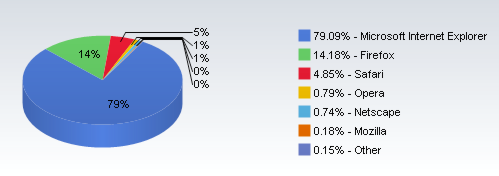
I looked in at MarketShare today at the browser trends, and Firefox’s share has grown to 14% from February last year. This is really good considering how many peopleBy people, throughout this post, I mean non techies. there are. Also, Firefox is a change–over browser, not a default one. Taking all those into consideration, 14% is a very positive number. Firefox 3.0 is not far away either, with features filled up to the brim (always a darling with new adopters). Mozilla and extension–ers make our job easier everyday! :)

Browser share for February 2007

Another reason why the share of IE is high is because mods like Avant and Maxthon build on the shell, and add a lot of features that Firefox and Opera have. This removes the incentive of ‘new’ features to make the switch. I wish there was a way to see what share of IE users actually use the bare naked IE. That would sure wipe the smile off a lot Microsoft faces.

My most recent experience of getting someone to switch was a few weeks back. Though it was initially a resounding ‘No!’ to start with, the mention of the words ‘better security’ and 'no spyware’ opened a door. I then went ahead to show little features like search suggests, search by name (I skipped the part that it exists in IE as well) and finally threw in the kahuna of extensions and themes. It sold rather well :P This was my second or third time handling a non–techie actually, and I learnt a few things on how to make the 'sale'.

I guess IE really has become extremely familiar to people. But atleast we’ve progressed away from calling IE the Internet. But Firefox’s clean and simple initial interface (compared to IE’s row full of buttons) does land in a good impression. IE sits well also because people don’t want to go to the hassle of having more than one application to do the same thing. They use the ‘why use Photoshop when we have Paint’ logic. It takes someone to ‘show’ them that Firefox is better. I don’t think there are many people who switch all by themselves. Also, once switched, they aren’t many who go looking for features. They use the brute force ways from IE on the new browser, until you show them that there is a better way to do it.

I know from my statistics that majority of my viewers use Firefox (even Apple viewers). That may have something to do with the fact that IE refuses to load up my search box, and stops midway. In the past I used to worry about that, and try to fix my templates to at least render (somehow) in IE. I guess it would increase my readership, but I doubt it’ll be a significant rise. My feed readership is 3 times my daily page views. So as long as the feed reader renders properly in IE, my posts will reach everyone :)

There is of course not a shadow of a doubt that IE can never be better than Firefox, or any other alternative browser. The underlying code, and it being closed to any kind of extensibility (easily codeable by people) will see to that. That is also the reason Opera is sitting at less than 1%. Closed doesn’t work that well, especially if you’re closed to suggestions as well.


26 March 2007

Twittering away!

If you have looked around my blog lately, you’d have noticed the ‘Aditya is…’ widget that I added to the right. I recently took it out, because I gave the updates a new purpose, but no points for guessing that it was powered by the latest fad on the Internet and what is being termed as ‘micro–blogging’ – Twitter. Twitter tries to answer the basic question … or actually, let’s ‘you’ answer the basic question, ‘What are you doing right now?’. But of course, used creatively, Twitter can be an amazing service which is accessible from something you carry around all the time. Your cell phone!

Staying connected

This is probably the best way to stay connected with a lot of people at the same time since mobile phones and IM. A single update to your Twitter, will fire off multiple messages to all those who follow you (on Twitter) with that update. I admit to not using Twitter to it’s ultimate potential. But that’s only because I cannot use it with my cell phone since the number to send a text message to is an international number for me (Twitter is based in UK). Regardless of this, I have tried to get my phone activated, but it hasn’t workedA mail to Twitter support also has reached to no particular end. This is something bad, since customer support should be the best thing about a site which has so many users..

But I have seen people updating from their phones, and I can imagine what a convenience it would be. The concept of constantly updating statuses was first introduced (to me) by Facebook. It has a nice module at the top right of the home page, which you can use to change your status. It gets reflected on all your friends’ mini–feeds. People have been using Twitter to keep friends and family updated on their latest trips and travels. The top bloggers (with the likes of names ending with Arrington and Malik on the bandwagon) used Twitter to keep their readers constantly updated throughout their run of SXSW '07.

Twitter isn’t a new thing however. There have been others like it, like Dodgeball. But for some reason, Twitter has really caught on like a wildfire on the Internet. With widgets and extensions getting into the play as well, staying connected was never so simple (and addictive!) :)

Bye bye to privacy

One thing that Twitter doesn’t have an option for is to remove people from your follower’s list. This can give a whole new meaning to the word ‘stalking’. That’s why, and this applies mostly to non–adults using this service, one should be careful when posting updates, and should use discretion while revealing current location, or what they’re doing. We’ve had enough of MySpace news about all this.

So, while this is an amazing service, it still has flaws. The lack of good customer support is one of them. Now, I want to see how far this actually goes to begin bringing people closer together, and trying to answer the basic question that you try to answer about your friends and family, ‘What are you doing right now?'!

Add me to your friends, and see what I’m upto the whole day :P
Happy twittering :)

Further

RIP Twitter (2007-2007)
Why is Twitter so slow
The post–its of blogging
Three innovative ways to use Twitter


23 March 2007

Time for new friends to reveal themselves!

Shutdown day!

Update: I have opened up the comments for the next 24 hours, and cleared away the moderation. Which means your comments will show up without any intervention from me as soon as you post them. I hope to not get spammed ;) This is because I am going to be taking part in Shutdown Day (24 March), so my computer will be off for the next 24 hoursYou will get to read my experience next week when I return!. The first day of de–lurking hasn’t been that satisfying … let’s see if tomorrow does the trick? Cheers!


From last year, when my blog surfaced, to today … my readership has gone from 18 to 270. Now that’s a freakin’ huge jump! :) I’m very thankful to all the people who come everyday to read whatever I have to babble about, but there are many more who like to stick around in their feed readers, quietly read a new post, and not say anything about it. I know some posts are too random to comment on, but surely you can leave something on some? ;)

Who are you?

So now, I’m going to take some time off to let you, my prized readers, show yourself. You might not have joined in the discussion about anything, but that doesn’t mean I don’t want to know who you are :) Through hacks, opinions, reviews, suggestions and what not, there are so many different people who come here, and for many more reasons …

The term given to this process is de-lurking. ‘Lurkers’ are those who come around for a visit, but don’t leave any comments because it’s already been said, or they don’t have anything to add. Now, I know that it’s not the celebrated ‘de–lurking’ dayI plan to make this a regular feature of the blog however, and from next time, it’ll be on the designated day!, but let’s do the opposite of that this time around … It’s ‘de–lurking’ time! :D

It could be a simple “Hi”, or an elaborate “Hello”! It could be in English, or any language you’re comfortable with. It doesn’t really matter. I just want to get a good idea of who the people are who actually take time out to read what I write. I’ll try and not add my two cents in the comments and break the flow. Leave your name, a brief introduction about yourself, and how you bumped in here––apart from anything else you might want to say––in your comment. Since there are about 270 subscribers, I hope to see atleast 70–75% of that number of comments. Let’s see how many people come out of their closets by coming Monday. I promise to release another hack if you manage to hit those numbers!

So! Show yourself! :) Let’s see who you all really are!


22 March 2007

Not another library!

Today I bumped into FrogJS. It’s another photo gallery ‘unobtrusive Javascript’ library, which can be used by people to make a Javascript driven animated photo gallery on their pages. My question is simple. Do we really need another one?

The whole list

There are enough libraries out in the field today. Prototype being the more famous and widely used one. Then there are the other players like mootools, SimpleJS and jQuery. These extend Javascript as a language. Individual libraries which add effects and other bling bling to your pages include moo.fx, which uses mootools as it’s base and script.aculo.us with Prototype for it’s base. Then for picture management there is the very famous Lightbox JS with Prototype as it’s base, and script.aculo.us for effects, and now FrogJS using the same. Phew! See what I mean?

It is not a question of which one is better, or faster, or smaller, or easier. It’s based on what ‘use’ you have of a library. There are many (and I emphasize) things in Prototype that go completely unused by people, but they still prefer to use it because it has a ‘few’ functions that help them get the job done faster. It makes more sense to just copy them out, or write your own (like I do). Otherwise, take time to analyse and learn what each library has to offer, and then use them as per your requirement. Don’t go for one because everyone is using it. Pretty much all the libraries offer the same things. ‘mootools’ actually makes things faster because it’s so small, so many people should look at that if they don’t have too many hardcore OOP uses in their scripts. If you do, Prototype is probably the way to go since it has some pretty amazing classes and objects handling.

I went skipping on from Particletree to a nice extension of Prototype, which contains even more teensy weensy functions which we all want and use, albeit with longer drawn out codes. For example, functions to work with cookies and such. It extends an already jam–packed and very useful library! :)

SimpleJS seems like a good deal for very basic use, with small file sizes and independence from any other framework. But it doesn’t offer anything too big, which someone working with a library might be looking for. jQuery on the other hand seems very interesting, with small (compressed) file size and seemingly lot of uses. I’m definitely going to look more into that one. I want to move away from Prototype, but my ‘Search Suggest’ requires script.aculo.us, which uses Prototype. Together, they add about 60–70 Kbs to every page. There is not much difference in time due to caching, but it’s still a heavy deal.

Pick and choose

There seems to be no real perfect choice, or quite a balanced on either. I think libraries can truly be a great addition to your arsenal, but only if you know how to make full use of them. That can always take time, and you need to stick with one to get to know it properly. I’ve used Prototype ever since it came out, in some form or the other, and I still don’t know all it’s uses. So you can imagine how big it can be. I might as well stick to it, because a few of the things I use on my blog need it anyway, and it’s filled to the brim with all the functions one will ever need.

What do you think about the libraries out there? And which do you think is better than the rest?


20 March 2007

Apollo: Java re-invented #

I had a few other posts waiting to be posted, but this news just deserves priority! When I first heard of Apollo, I wasn’t so excited as a lot of people have been. I was more of the thought that since Adobe just likes to do things their way, no matter what, Apollo will be nothing but a fancier version of Java. I’m glad to say, that reading everything post release, I was right … for the most part.

The similarities end at the ‘cross–OS runtime’, because Apollo aims to become what Java couldn’t. Apollo is going to take what we already know, leverage it to the OS, and hand the controls back into our hands. What this simply means is that, everything you could do with the Internet, is now available for you to do with your own computer. I had written about seamless integration of offline and online applications. Keeping that in mind, this seems like just the thing I was looking for! :)

Why the Java analogy?

For those who don’t know, Sun Microsystems developed Java as a higher level language, which aimed to be completely object–oriented (it does this freakin’ well!), cross–platform and relatively easier to work with compared with lower level C++/C and the likes. But there was a problem. Working with Java meant learning a whole new language. Those familiar, will know that Java’s (only?) failing is its monstrous syntax linessystem.out.write just to write ‘Hi’ on the screen? Don’t get me started on higher functions!. I’m no expert though, and while it is the most popular programming language today, I think it can be seriously improved upon.

This is where Apollo will succeed, since it works by using existing web languages and technologiesHTML, Javascript, CSS, Flex, AJAX and ActionScript (non–web). PHP isn’t supported, and no plans have been revealed yet to do so. I guess one will have to use AS to bridge that gap should the need arise. I don’t know about Flex, so I guess that could be useful too!, and let’s you write applications using them. Web languages have been under heavy use since the Web 2.0 boom, and there are ‘many’ people who know it and use it in everyday life, with more and more beginning to join in the fray. If nothing more, a simple HTML interface to a Javascript backend, with Apollo’s stream controls should be able to help in developing simple and task specific applications. I can sense a Textmate for windows :)

Restricted freedom

This will, however, not be for newbies, surely. You’ll need to be adept at using existing technologies to be able to get your hands dirty with Apollo. You’ll have to be familiar with the basics of a how compilers and memory based languages work. But I think Adobe would have life much easier for everyone. So much so, that the first application that comes to mind is a ‘desktop dashboard’ of your Blogger. It could be synchronised whenever you’d go online, but for the times you were offline, changes could be saved locally, and then using the Blogger ATOM API, upload all the changes to your account. This might be one of the most uncreative uses of this however … :P So you can imagine the possibilities.

So, while Apollo looks and feels amazing, a true analysis can only come when people start to use it and get a feel for it themselves. But mark my words. This is going to be big. So big that next generation applications will be made off Apollo type frameworks. And yes, Apollo is surely going to generate some spinoffs and libraries. But ultimately, if application development becomes easier, why not? :)

Further Reading

Introducing Apollo
Apollo Developer FAQ
Apollo just launched, so go build something